


Page 48 - Abbott
P. 48
After RHC and sensor implantation, all patients had follow-up study visits at 1 month, 3 months, 6 months, and every 6 months
               thereafter until study termination.
               Study Endpoints
               The primary and secondary endpoints were evaluated after 6 months of patient follow-up. The primary safety endpoints were
               1) Freedom from device / system-related complications (DSRC), and 2) Freedom from pressure sensor failures. The primary efficacy
               endpoint was the rate of HF hospitalizations. All hospitalizations were adjudicated by an independent Clinical Events Committee
               (CEC) who were blinded to treatment assignment. Secondary endpoints were tested in a hierarchical fashion and included changes
               in PA pressures, proportion of subjects hospitalized for HF, days alive outside of the hospital for HF, and quality of life. Because
               blinded follow-up continued until the last patient completed 6 months of follow-up, the average patient follow-up was much longer
               (17.6 months) and pre-specified supplementary analyses were conducted on the full duration of follow-up data (Randomized
               Access).
               Patient Demographics and Disposition
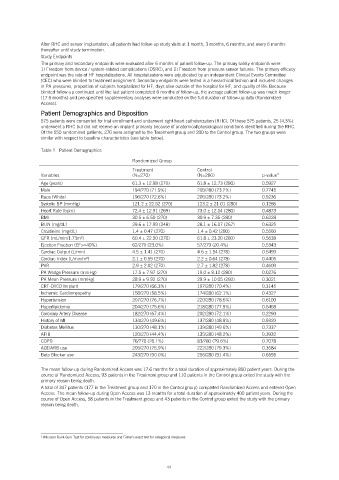
               575 patients were consented for trial enrollment and underwent right heart catheterization (RHC). Of these 575 patients, 25 (4.3%)
               underwent a RHC but did not receive an implant primarily because of anatomical/physiological conditions identified during the RHC.
               Of the 550 randomized patients, 270 were assigned to the Treatment group and 280 to the Control group. The two groups were
               similar with respect to baseline characteristics (see table below).
               Table 2.  Patient Demographics
                                                Randomized Group

                                                Treatment             Control
                                                                                                  2
               Variables                        (N=270)               (N=280)                p-value
               Age (years)                      61.3 ± 12.98 (270)    61.8 ± 12.73 (280)     0.5927
               Male                             194/270 (71.9%)       205/280 (73.2%)        0.7745
               Race (White)                     196/270 (72.6%)       205/280 (73.2%)        0.9236
               Systolic BP (mmHg)               121.2 ± 22.52 (270)   123.2 ± 21.01 (280)    0.1286
               Heart Rate (bpm)                 72.4 ± 12.91 (269)    73.0 ± 12.14 (280)     0.4873
               BMI                              30.5 ± 6.50 (270)     30.9 ± 7.35 (280)      0.6228
               BUN (mg/dL)                      29.6 ± 17.99 (248)    28.1 ± 16.17 (267)     0.6325
               Creatinine (mg/dL)               1.4 ± 0.47 (270)      1.4 ± 0.42 (280)       0.5560
               GFR (mL/min/1.73m²)              60.4 ± 22.50 (270)    61.8 ± 23.20 (280)     0.5638
               Ejection Fraction (EF>=40%)      62/270 (23.0%)        57/279 (20.4%)         0.5343
               Cardiac Output (L/min)           4.5 ± 1.41 (270)      4.6 ± 1.54 (278)       0.5499
               Cardiac Index (L/min/m²)         2.1 ± 0.59 (270)      2.2 ± 0.64 (278)       0.4405
               PVR                              2.9 ± 2.02 (270)      2.7 ± 1.82 (278)       0.4609
               PA Wedge Pressure (mmHg)         17.5 ± 7.97 (270)     19.0 ± 8.12 (280)      0.0276
               PA Mean Pressure (mmHg)          28.9 ± 9.92 (270)     29.9 ± 10.05 (280)     0.3021
               CRT-D/ICD Implant                179/270 (66.3%)       197/280 (70.4%)        0.3145
               Ischemic Cardiomyopathy          158/270 (58.5%)       174/280 (62.1%)        0.4327
               Hypertension                     207/270 (76.7%)       220/280 (78.6%)        0.6100
               Hyperlipidemia                   204/270 (75.6%)       218/280 (77.9%)        0.5458
               Coronary Artery Disease          182/270 (67.4%)       202/280 (72.1%)        0.2290
               History of MI                    134/270 (49.6%)       137/280 (48.9%)        0.9320
               Diabetes Mellitus                130/270 (48.1%)       139/280 (49.6%)        0.7337
               AFIB                             120/270 (44.4%)       135/280 (48.2%)        0.3932
               COPD                             76/270 (28.1%)        83/280 (29.6%)         0.7078
               ACE/ARB use                      205/270 (75.9%)       222/280 (79.3%)        0.3584
               Beta Blocker use                 243/270 (90.0%)       256/280 (91.4%)        0.6595

               The mean follow-up during Randomized Access was 17.6 months for a total duration of approximately 800 patient years. During the
               course of Randomized Access, 93 patients in the Treatment group and 110 patients in the Control group exited the study with the
               primary reason being death.
               A total of 347 patients (177 in the Treatment group and 170 in the Control group) completed Randomized Access and entered Open
               Access. The mean follow-up during Open Access was 13 months for a total duration of approximately 400 patient years. During the
               course of Open Access, 58 patients in the Treatment group and 43 patients in the Control group exited the study with the primary
               reason being death.


               2  Wilcoxon Rank-Sum Test for continuous measures and Fisher's exact test for categorical measures.


                                                            44

