


Page 49 - Abbott
P. 49
Primary and Secondary Endpoint Results
                Primary Safety Endpoints
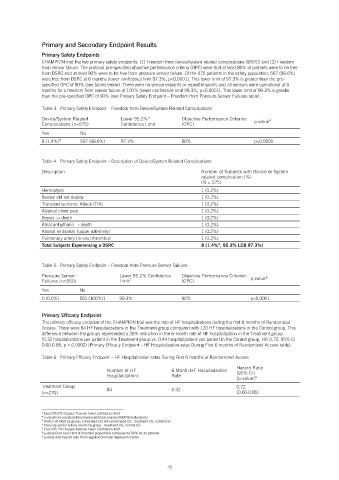
                CHAMPION met the two primary safety endpoints: (1) Freedom from device/system related complications (DSRC) and (2) Freedom
                from sensor failure. The protocol pre-specified objective performance criteria (OPC) were that at least 80% of patients were to be free
                from DSRC and at least 90% were to be free from pressure sensor failure. Of the 575 patients in the safety population, 567 (98.6%)
                were free from DSRC at 6 months (lower confidence limit 97.3%, p<0.0001). This lower limit of 97.3% is greater than the pre-
                specified OPC of 80% (see tables below). There were no sensor explants or repeat implants and all sensors were operational at 6
                months for a freedom from sensor failure of 100% (lower confidence limit 99.3%, p<0.0001). This lower limit of 99.3% is greater
                than the pre-specified OPC of 90% (see Primary Safety Endpoint – Freedom from Pressure Sensor Failures table).

                Table 3.  Primary Safety Endpoint – Freedom from Device/System Related Complications
                                                     3
                Device/System Related      Lower 95.2%           Objective Performance Criterion   p-value
                                                                                                4
                Complications (n=575)      Confidence Limit      (OPC)
                Yes          No
                      5
                8 (1.4%)     567 (98.6%)   97.3%                 80%                      p<0.0001


                Table 4.  Primary Safety Endpoint – Description of Device/System Related Complications
                Description                                             Number of Subjects with Device or System
                                                                        related complication (%)
                                                                        (N = 575)
                Hemoptysis                                              1 (0.2%)
                Sensor did not deploy                                   1 (0.2%)
                Transient Ischemic Attack (TIA)                         1 (0.2%)
                Atypical chest pain                                     1 (0.2%)
                Sepsis → death                                          1 (0.2%)
                Atrial arrhythmia → death                               1 (0.2%)
                Arterial embolism (upper extremity)                     1 (0.2%)
                Pulmonary artery (in-situ) thrombus                     1 (0.2%)
                                                                              6
                Total Subjects Experiencing a DSRC                      8 (1.4% , 95.2% LCB 97.3%)


                Table 5.  Primary Safety Endpoint – Freedom from Pressure Sensor Failures
                Pressure Sensor            Lower 95.2% Confidence   Objective Performance Criterion   p-value
                                                                                              8
                                               7
                Failures (n=550)           Limit                 (OPC)
                Yes          No
                0 (0.0%)     550 (100%)1   99.3%                 90%                     p<0.0001

                Primary Efficacy Endpoint
                The primary efficacy endpoint of the CHAMPION trial was the rate of HF hospitalizations during the first 6 months of Randomized
                Access. There were 84 HF hospitalizations in the Treatment group compared with 120 HF hospitalizations in the Control group. This
                difference between the groups represented a 28% reduction in the 6-month rate of HF hospitalization in the Treatment group
                (0.32 hospitalizations per patient in the Treatment group vs. 0.44 hospitalizations per patient in the Control group, HR 0.72, 95% CI
                0.60-0.85, p = 0.0002) (Primary Efficacy Endpoint – HF Hospitalization rates During First 6 months of Randomized Access table).

                Table 6.  Primary Efficacy Endpoint – HF Hospitalization rates During First 6 months of Randomized Access
                                                                                    Hazard Ratio
                                       Number of HF          6 Month HF Hospitalization
                                       Hospitalizations      Rate                   (95% CI)
                                                                                           9
                                                                                    [p-value]
                Treatment Group        84                    0.32                   0.72
                (n=270)                                                             (0.60-0.85)


                3  Exact 95.2% Clopper-Pearson lower confidence limit
                4  p-valuefromexacttestofbinomialproportionscomparedto80%forallpatients
                5  DSRCs (8 total) by group: Consented but not randomized (2), Treatment (3), Control (3)
                6  Pressure sensor failure counts by group: Treatment (0), Control (0)
                7  Exact 95.2% Clopper-Pearson lower confidence limit
                8  p-value from exact test of binomial proportions compared to 90% for all patients
                9  p-value and hazard ratio from negative binomial regression model


                                                            45

