


Page 34 - Abbott
P. 34
B. Technically Suspect Readings
Technically suspect readings are readings which result from a signal other than the sensor.
If you receive technically suspect readings that have a high signal strength (> 70% ) within the search range of the sensor:
Be aware of the angulation of the sensor relative to the antenna and have the patient shift positions until the suspect reading
minimizes.
Place the antenna between the operator and the patient.
Relocate to a different room.
See section Solutions for Interference below.
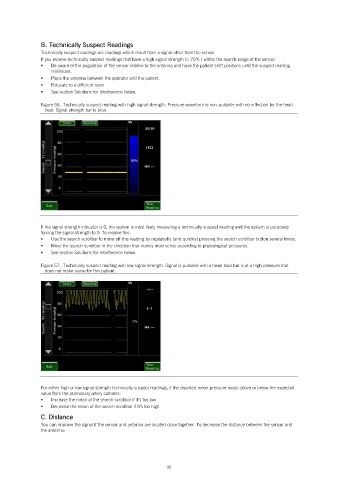
Figure 56. Technically suspect reading with high signal strength. Pressure waveform is non-pulsatile with no inflection for the heart
beat. Signal strength bar is blue.
If the signal strength indicator is 0, the system is most likely measuring a technically suspect reading and the system is purposely
forcing the signal strength to 0. To resolve this:
Use the search scrollbar to move off this reading by repeatedly (and quickly) pressing the search scrollbar button several times.
Move the search scrollbar in the direction that makes most sense according to physiological pressures.
See section Solutions for Interference below.
Figure 57. Technically suspect reading with low signal strength. Signal is pulsatile with a heart beat but is at a high pressure that
does not make sense for this patient.
For either high or low signal strength technically suspect readings, if the reported mean pressure reads above or below the expected
value from the pulmonary artery catheter:
Increase the mean of the search scrollbar if it’s too low
Decrease the mean of the search scrollbar if it’s too high
C. Distance
You can improve the signal if the sensor and antenna are located close together. To decrease the distance between the sensor and
the antenna:
30

