


Page 67 - Abbott
P. 67
The system should not be modified. The user of this equipment is responsible for reading, understanding, and following the Warning
                and Precaution statements presented within this manual.
                Electromagnetic Interference and Electromagnetic Compatibility

                This section provides a brief overview of Electromagnetic Interference and Electromagnetic Compatibility guidance associated with
                the use of the CM3000.

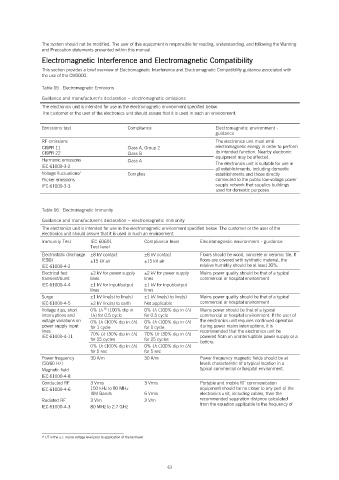
                Table 15.  Electromagnetic Emissions
                Guidance and manufacturer’s declaration – electromagnetic emissions
                The electronics unit is intended for use in the electromagnetic environment specified below.
                The customer or the user of the electronics unit should assure that it is used in such an environment.

                Emissions test                Compliance                     Electromagnetic environment -
                                                                             guidance
                RF emissions                                                 The electronics unit must emit
                CISPR 11                      Class A, Group 2               electromagnetic energy in order to perform
                CISPR 22                      Class B                        its intended function. Nearby electronic
                Harmonic emissions            Class A                        equipment may be affected.
                IEC 61000-3-2                                                The electronics unit is suitable for use in
                                                                             all establishments, including domestic
                Voltage fluctuations/         Complies                       establishments and those directly
                Flicker emissions                                            connected to the public low-voltage power
                IEC 61000-3-3                                                supply network that supplies buildings
                                                                             used for domestic purposes.


                Table 16.  Electromagnetic Immunity
                Guidance and manufacturer’s declaration – electromagnetic immunity
                The electronics unit is intended for use in the electromagnetic environment specified below. The customer or the user of the
                electronics unit should assure that it is used in such an environment.
                Immunity Test    IEC 60601          Compliance level   Electromagnetic environment - guidance
                                 Test level
                Electrostatic discharge  ±8 kV contact   ±8 kV contact   Floors should be wood, concrete or ceramic tile. If
                (ESD)            ±15 kV air         ±15 kV air         floors are covered with synthetic material, the
                IEC 61000-4-2                                          relative humidity should be at least 30%.
                Electrical fast   ±2 kV for power supply   ±2 kV for power supply   Mains power quality should be that of a typical
                transient/burst   lines             lines              commercial or hospital environment
                IEC 61000-4-4    ±1 kV for input/output   ±1 kV for input/output
                                 lines              lines
                Surge            ±1 kV line(s) to line(s)   ±1 kV line(s) to line(s)   Mains power quality should be that of a typical
                IEC 61000-4-5    ±2 kV line(s) to earth   Not applicable   commercial or hospital environment
                Voltage dips, short   0% UT  (100% dip in   0% UT (100% dip in UT)   Mains power should be that of a typical
                                     15
                interruptions and   UT) for 0.5 cycle   for 0.5 cycle   commercial or hospital environment. If the user of
                voltage variations on   0% UT (100% dip in UT)   0% UT (100% dip in UT)   the electronics unit requires continued operation
                power supply input   for 1 cycle    for 1 cycle        during power mains interruptions, it is
                lines                                                  recommended that the electronics unit be
                IEC 61000-4-11   70% UT (30% dip in UT)   70% UT (30% dip in UT)   powered from an uninterruptible power supply or a
                                 for 25 cycles      for 25 cycles      battery.
                                 0% UT (100% dip in UT)   0% UT (100% dip in UT)
                                 for 5 sec          for 5 sec
                Power frequency   30 A/m            30 A/m             Power frequency magnetic fields should be at
                (50/60 Hz)                                             levels characteristic of a typical location in a
                Magnetic field                                         typical commercial or hospital environment.
                IEC 61000-4-8
                Conducted RF     3 Vrms             3 Vrms             Portable and mobile RF communication
                IEC 61000-4-6    150 kHz to 80 MHz                     equipment should be no closer to any part of the
                                 ISM Bands          6 Vrms             electronics unit, including cables, than the
                Radiated RF      3 V/m              3 V/m              recommended separation distance calculated
                IEC 61000-4-3    80 MHz to 2.7 GHz                     from the equation applicable to the frequency of


                15  UT is the a.c. mains voltage level prior to application of the test level.


                                                            63

